Rising to an immense 8,163 meters (26,781 ft) in the Mansiri Himal of west-central Nepal, Manaslu holds court as the eighth-highest mountain in the world. Its name originates from the Sanskrit word Manasa, meaning "intellect" or "soul"—earning it the poetic title "The Mountain of the Spirit."
Standing solitary and tall, Manaslu dominates the horizon with long, serrated ridges and tumbling valley glaciers. For mountaineers, its snowy northeast face has become the premier post-monsoon 8,000-meter target, while the ancient trading corridor circling its perimeter forms one of the most culturally authentic, teahouse-trekking circuits left in the Himalayas.
History: The Japanese Mountain of 1956
Just as the British laid historical claim to Everest and the French to Annapurna, Manaslu is affectionately remembered as "the Japanese peak." Following multiple exploratory expeditions throughout the early 1950s, a Japanese team led by Aritsune Maki achieved the coveted first ascent on May 9, 1956. Toshio Imanishi and Gyalzen Norbu Sherpa stood on the summit, cementing a proud bond between Japan and the people of the Budi Gandaki valley.
The route to the summit was not without fierce conflict. In 1954, an avalanche wiped out an ancient monastery in the village of Samagaon, and the local community attributed the divine wrath to the foreign climbers disturbing their sacred mountain. The expedition retreated respectfully, returning only after negotiations, monetary gifts to rebuild the gompa, and formal blessings smoothed relations. Decades later, Manaslu remains a formidable technical test, notoriously prone to heavy post-monsoon snowfall and sudden, avalanching seracs.
Myth & Spiritual Lore: The Abode of the Soul Deity
To the indigenous Nubri and Tsum peoples who trace their ancestry directly back to Tibet, Manaslu is neither a playground for climbers nor an inanimate block of frozen stone:
- The Wrathful Mountain Protector: Local folklore holds that the mountain is the physical throne of a wrathful deity named Pungyen, who watches over the prosperity of the valley's livestock, crops, and winter weather.
- The Pungyen Gompa Legend: Tucked on a high glacial plateau directly beneath the sheer eastern wall of Manaslu sits Pungyen Gompa, a sanctuary with over four centuries of history. Legend warns that if anyone ascends the mountain without proper spiritual permission and a pure heart, Pungyen unleashes violent blizzards and devastating rockslides to protect the mountain's sanctity.
The Buddhist Legacy: Bon Chortens & Sacred Sanctuaries
The trails winding through the Manaslu Conservation Area are living open-air museums of Tibetan Vajrayana Buddhism and ancient, pre-Buddhist Bon practices:
- Centuries-Old Mani Walls: In villages like Lho, Shyala, and Samagaon, trails run alongside some of the longest carved mani walls in Nepal. These stone slabs, hand-chiseled with the mantra Om Mani Padme Hum and depictions of Chenrezig, must always be passed, keeping them on your right (clockwise).
- The Ribang Gompa & Monastic Life: At Lho village, the grand Ribang Gompa perches on a hilltop, framed perfectly by the double peaks of Manaslu looming directly behind its golden roof. Young novice monks study Buddhist scriptures here, their chanting echoing against the valley walls at dawn.
- The Hidden Beyul Kyimolung: The valley borders the sacred valley of Kyimolung, a hidden sanctuary consecrated by Guru Padmasambhava in the 8th century as a safe haven of peace and non-violence (Ahimsa), where hunting, killing animals, and felling sacred forests are strictly taboo.
High-Altitude Ecology: Flora & Fauna of the Budi Gandaki
Circling Manaslu takes trekkers through one of the steepest biological transitions on Earth, climbing from subtropical rice terraces to glaciated passes:
- Flora: Lower river gorges are choked with wild bamboo groves, towering sal trees, and waterfalls draped in orchids. Above 3,000 meters, you hike through dense, mossy forests of blue pine, birch, and magnificent arboreal rhododendrons. Approaching Samdo, trees surrender to alpine scrub, aromatic sunpati (Rhododendron anthopogon), dwarf junipers, and resilient cushion plants clinging to frozen moraines.
- Fauna: The protected status of the conservation area makes it a premier stronghold for wildlife. The rocky crags above Samagaon are prime grazing territory for large herds of Himalayan Blue Sheep (Bharal), which are closely tracked by the endangered Snow Leopard (Panthera uncia). Hikers often spot the Himalayan Musk Deer darting through the birch groves, agile Himalayan Tahr skipping across vertical rocks, and Tibetan snowcocks running along scree fields.
Mountain Fuel: Nubri Valley Teahouse Delights
Sustenance around Manaslu reflects authentic high-altitude mountain life, borrowing heavily from Tibetan culinary traditions:
- Tsampa & Chhurpi Porridge: Roasted highland barley flour mixed with warm, sweetened milk or churned salty yak butter tea (Su-Chya)—the ultimate slow-burning energy food for long mountain walks.
- Samagaon Potato Curry & Buckwheat Roti: Thick, dense buckwheat flatbreads (Fapar ko Roti) served piping hot from the hearth with curried local mountain potatoes and a spoonful of pungent, fermented chili-garlic pickle.
- Hearty Thukpa & Sherpa Stew (Syakpa): Deep bowls of thick, hand-rolled wheat noodles and wild greens simmered in a heavy, steaming broth packed with crushed garlic to assist with circulation and acclimatization.
The Trek: The Epic Manaslu Circuit & Larkya La
The Manaslu Circuit is universally considered the purest teahouse alternative to the classic Annapurna Circuit, retaining a raw, remote wilderness character:
- The Canyon Approach: Starting at Soti Khola or Machha Khola, the trail carves its way through the dramatic, roaring gorge of the Budi Gandaki River, crossing hair-raising cantilever suspension bridges hung high over raging whitewater.
- The High Alpine Acclimatization: Rest days in Samagaon (3,530 m) offer breathtaking day hikes to Manaslu Base Camp (4,800 m) or the turquoise glacial lake of Birendra Tal, where chunks of ice calve from Manaslu’s glaciers directly into the water.
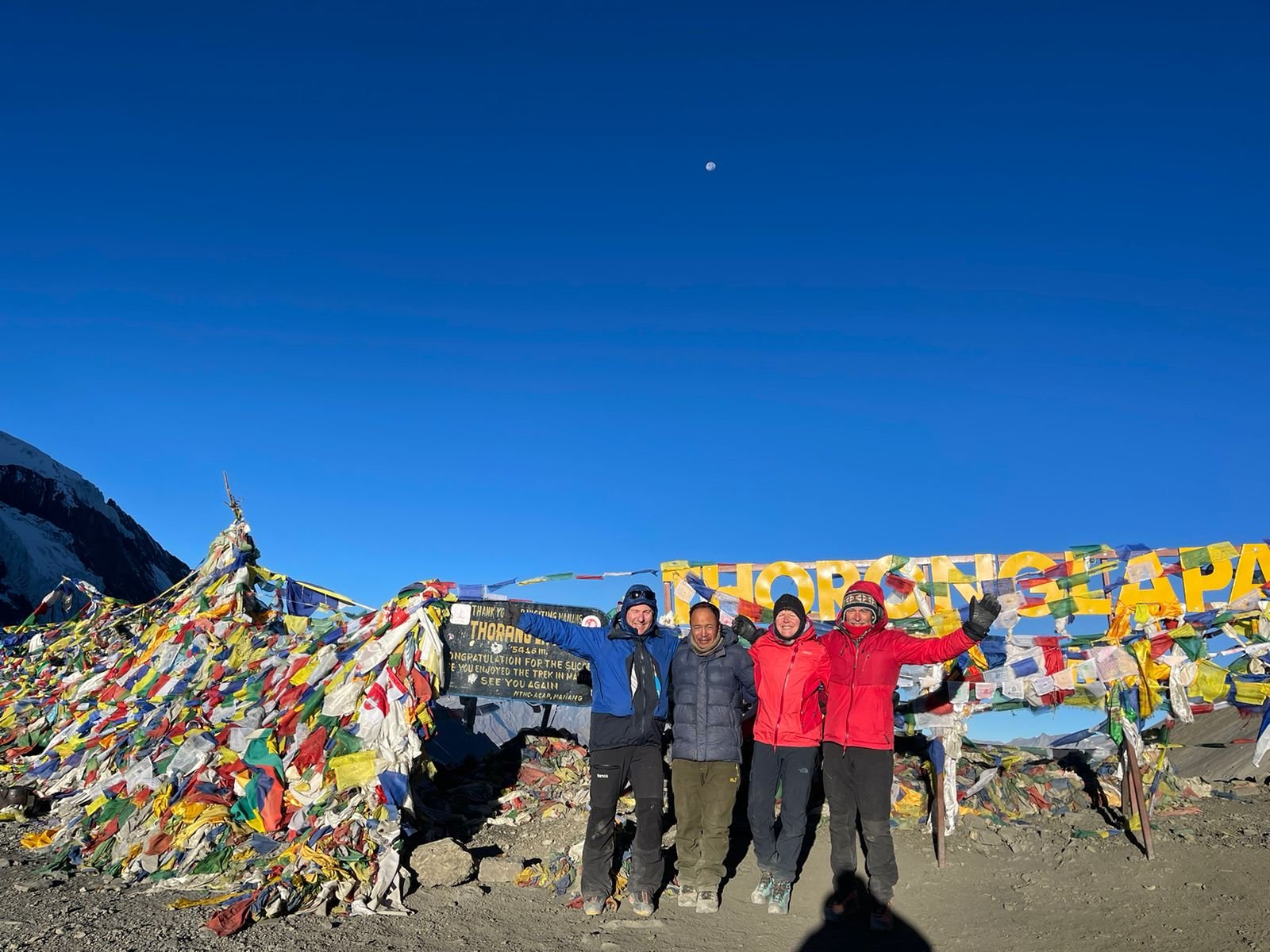
- Crossing the Larkya La Pass (5,106 m): The climax of the circuit is a pre-dawn climb from Dharmasala over the windswept Larkya La Pass. It is a grueling, loose-rock and snow ridge walk rewarded by an immense, panoramic amphitheater of frozen giants: Himlung Himal, Cheo Himal, Gyaji Kang, Kang Guru, and the Annapurna II massif.
Best Seasons:
- Autumn (September–November): Crisp, cloudless skies, dry high-pass conditions, and gold-hued buckwheat fields ready for harvest.
- Spring (March – May): Blooming rhododendron forests along the gorge trails, thawing high lakes, and lively climbing expeditions setting up base camp.
Manaslu is a journey into the wild, beating heart of the Himalayas. It demands sweat, patience on narrow canyon trails, and respect for high-altitude weather, but it rewards travelers with an untouched world where ancient Tibetan Buddhism and raw alpine geology live in seamless harmony. To cross the prayer-flag-strewn crest of Larkya La at sunrise, looking back at the colossal ice pyramid of the Mountain of the Spirit rising into the blue void, is an encounter with the sublime that echoes in your soul for a lifetime.