Sprawling across the flat, fertile Terai lowlands of Banke District at an elevation of roughly 150 meters (492 ft), Nepalgunj is the commercial, transportation, and cultural powerhouse of mid- and far-western Nepal. Situated just 16 kilometers south of Kohalpur and hugging the southern border with Uttar Pradesh, India, the city hums with the dynamic energy of a historic border mart.
To mountain travelers, trekkers, and pilgrims, Nepalgunj holds an almost mythical reputation: it is the primary aviation threshold to the wild Karnali. When flights take off from its runway, they leave behind scorching summer plains to deliver adventurers into the thin-air airstrips of Simikot, Juphal, and Talcha—unlocking journeys to Shey Phoksundo, Rara Lake, and Mount Kailash. Yet beneath its transit hub exterior lies an ancient, multi-faith town steeped in Awadhi heritage, street-food lanes, and sacred Shakta devotion.

History: The "Naya Muluk" & The Border Trade Nexus
Unlike medieval hill capitals with roots tracing back millennia, modern Nepalgunj owes its expansion to 19th-century diplomacy and commerce. Following the 1857 Indian Uprising (Sepoy Mutiny), Prime Minister Jung Bahadur Rana provided crucial military assistance to the British East India Company. In gratitude, the British restored a strip of the southwestern Terai plains to Nepal in 1860—a territory historically dubbed Naya Muluk ("The New Country"), comprising Banke, Bardiya, Kailali, and Kanchanpur.
Recognizing the strategic potential of Banke, the Rana administration systematically laid out Nepalgunj as a planned border trading mart. It quickly became the regional collection point where Himalayan mountain products—herbs like Yarsagumba, handwoven wool, clarified butter (ghee), and timber—were exchanged for cotton fabrics, salt, iron, and manufactured goods arriving from India. The town's commercial backbone grew around the iconic Tribhuvan Chowk and Dhamboji, retaining a historic blend of hill migrants, Newar merchants, Awadhi tradespeople, and Muslim artisans.
Sacred Lore: The Tongue of Sati Devi & The Mustachioed Shiva
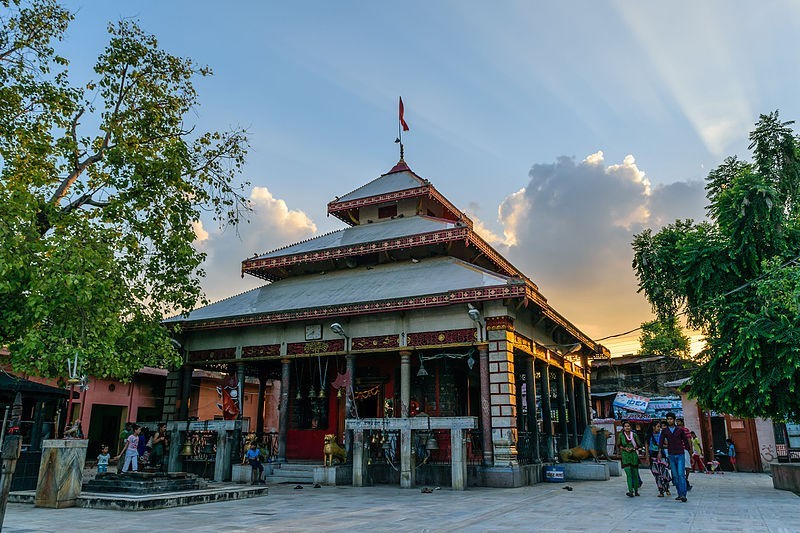
Spiritual life in Nepalgunj centers around the revered Bageshwori Temple, one of the most prominent Shakti Peethas in the western plains:
- The Legend of Sati’s Tongue: According to Hindu epic lore, when Lord Shiva wandered the universe carrying the lifeless body of his consort Sati Devi, her body parts severed by Vishnu’s discus fell across sacred locations (Shakti Peethas). Lore holds that Sati Devi's tongue fell upon this very spot in Nepalgunj. The goddess is worshipped here as Bageshwori (a fierce manifestation of Durga), and pilgrims flock to the inner sanctum to seek divine blessings, protection, and fulfillment of vows.
- Junge Mahadev (The Mustachioed Shiva): At the center of the large sacred Bageshwori Pond stands a rare architectural anomaly: a temple dedicated to Lord Shiva featuring a distinct, prominent mustache (Junge Mahadev). While depictions of Shiva across South Asia almost universally show a smooth, ascetic face, this temple's warrior-like icon is one of only two such statues in Nepal, commanding deep reverence and curiosity.

Cultural Fabric: A Living Awadhi & Interfaith Mosaic
Nepalgunj is celebrated for its deep intercommunal harmony, where diverse faiths and languages have shared streets for generations:
- The Awadhi Heartland: While Nepali serves as the administrative lingua franca, the cultural cadence of the city beats to Awadhi—the sweet, melodic language spoken natively across the surrounding plains. The region's poetry, music, and seasonal celebrations reflect the shared traditions of the broader Awadh cultural sphere.
- Minarets and Temple Bells: The city showcases a vibrant Muslim heritage, home to some of the largest and oldest madrasas and mosques in the Terai. The call to prayer (Adhan) from historic minarets drifts across the same neighborhoods where Bageshwori's evening bells ring, and festivals like Eid, Moharram, Dashain, and Chhath are celebrated with communal enthusiasm.
Ecology & The Surrounding Wilds: Banke & Bardia
Situated on the Gangetic plain, the natural environment around Nepalgunj transitions between agricultural fields and dense tropical wilderness:
- Flora: The outer fringes are dominated by expansive forests of straight-trunked Sal (Shorea robusta), interspersed with Asna (Terminalia alata), Khair (Acacia catechu), and flowering red silk-cotton (Semal). During the sweltering pre-monsoon heat, yellow laburnum blossoms (Amaltas) cascade over street walls like showers of gold.
- Fauna & National Parks: Nepalgunj serves as the jumping-off point for two major wildlife reserves. Just east lies Banke National Park (established in 2010 as a tiger conservation corridor), while a short drive west leads to Bardia National Park—famed for its healthy populations of Royal Bengal Tigers, wild Asian elephants, and one-horned rhinos. Within the city itself, fruit bat colonies roost in century-old trees, while egrets and sarus cranes stalk the seasonal wetlands.
Culinary Heartland: The Street Food Capital of the Plains
Nepalgunj is affectionately celebrated across the country as a food lover's paradise, boasting a rich culinary identity distinct from the hills:
- Tribhuvan Chowk Rabadi: The undisputed signature delicacy of Nepalgunj. Thick, creamy buffalo milk is simmered and reduced for hours over slow coals until it forms rich, sweet layers of clotted cream, served chilled in leaf cups or earthen pots.
- Rahim Biryani & Sekuwa: The town's Muslim quarter is famed for fragrant Awadhi-style mutton biryani cooked in massive copper cauldrons (deg), as well as succulent skewers of spicy charred buffalo and goat meat (Sekuwa).
- Ghamanja & Chaat: A quintessential morning street breakfast consisting of crispy fried snacks—bread tikia, potato pakodas, spicy green chilies, and fried chickpeas—smothered in rich chickpea gravy and tangy tamarind water.
- Chilled Matka Lassi: Thick, sweetened churned yogurt served in unglazed clay cups, crowned with a dollop of fresh clotted cream and crushed pistachios—the ultimate antidote to the scorching midday heat.

Travel & The Gateway Role: Linking Lowlands to High Peaks
For trekkers and regional travelers, Nepalgunj is the indispensable nerve center of the west:
- Ranjha Airport (Nepalgunj Airport): One of the busiest domestic hubs in the country. It operates high-altitude STOL (Short Takeoff and Landing) flights into western mountain valleys:
- Flights north to Talcha (Mugu) provide rapid access to the tranquil sapphire waters of Rara Lake.
- Flights to Juphal (Dolpa) unlock the arid, ancient Bon communities and turquoise abyss of Shey Phoksundo Lake.
- Flights to Simikot (Humla) serve as the historic launching pad for the trans-Himalayan overland trek to Mount Kailash and Lake Manasarovar across the Tibetan border.
Best Seasons to Visit:
- Winter (November–February): Mild, pleasant daytime weather (around 18–24°C) with cool evenings, ideal for temple exploration and street-food walks.
- Autumn & Spring (September – October & March – April): Prime transit windows when flight schedules to Karnali and Dolpo airstrips operate with the highest reliability. Summers (May–June) can be fiercely hot, often exceeding 40°C.
Nepalgunj is far more than a transit terminal on the edge of the runway. It is a soulful, aromatic melting pot where the ancient rhythms of the Awadh plains meet the rugged frontier spirit of the western mountains. To sit by Tribhuvan Chowk at dusk as the air cools, savoring a warm clay cup of rabadi while the scent of roasting spices mingles with the evening bells of Bageshwori Temple, is to experience the vibrant, hospitable heart of Nepal’s southwestern plains.