Towering at 8,091 meters (26,545 ft) in north-central Nepal, Annapurna I is the tenth-highest mountain on Earth and the crowning titan of a 55-kilometer-long massif. Flanked by the world's deepest river canyon—the Kali Gandaki Gorge—to the west and the Marshyangdi river valley to the east, Annapurna is a mountain of profound contrasts.
While its fertile foothills feed terraced fields across the mid-hills, the main peak itself is a sheer citadel of unstable seracs, knife-edge cornices, and perpetual avalanche chutes. Mountaineers view Annapurna with deep respect: historically, it has carried one of the highest fatality-to-summit ratios among all fourteen 8,000-meter peaks, making it an alpine proving ground where raw power and volatile weather reign supreme.
History: The Golden French Triumph of 1950
Annapurna holds an immortal place in climbing history as the very first 8,000-meter peak ever summited by humankind. Long before Everest was climbed in 1953, a French expedition led by Maurice Herzog ventured into what was then largely unmapped territory.
On June 3, 1950, Maurice Herzog and Louis Lachenal reached the summit via the North Face without supplemental oxygen. The descent became legendary for its sheer survival grit: battling severe frostbite, blinding snowstorms, and lost gear, both climbers lost their toes and fingers to gangrene, carried down through the monsoon jungles on the backs of loyal Sherpa companions. Herzog’s subsequent memoir, Annapurna, introduced the majesty and terror of the high Himalayas to the post-war world with its famous closing line: "There are other Annapurnas in the lives of men."
Twenty years later, in 1970, a British expedition led by Chris Bonington shattered the boundaries of modern mountaineering by scaling the nearly vertical, 3,000-meter South Face, ushering in the modern era of technical Himalayan wall climbing.
Myth & Sacred Lore: The Goddess of Plentiful Harvests
In Sanskrit and Hindu tradition, Annapurna translates directly to "Giver of Food and Nourishment"—derived from Anna (food or grain) and Purna (full or complete).
- The Manifestation of Parvati: The mountain is revered as an earthly embodiment of the goddess Parvati in her divine role as Annapurna, the cosmic provider who feeds the world and wards off famine. According to lore, when Shiva once proclaimed the material world was an illusion (maya), food vanished from the universe, bringing drought and starvation. Seeing the suffering of mortals, Parvati appeared as Goddess Annapurna in a golden kitchen, dispensing steaming bowls of grain to gods and mortals alike—including Shiva himself, who came begging at her altar.
- The Annapurna Sanctuary Lore: The high glacial amphitheater known as the Annapurna Sanctuary (the basin leading to Annapurna Base Camp) was traditionally held as sacred ground by the indigenous Gurung and Magar peoples. Historically, meat, eggs, and footwear were forbidden inside the inner sanctuary to avoid polluting the pure domain of the goddess and disturbing the guardian spirits residing beneath Machapuchare and Annapurna South.
The Buddhist & Animist Legacy: Gateway to the Kali Gandaki
Annapurna anchors an ancient spiritual corridor where Tibetan Buddhism, Hinduism, and pre-Buddhist traditions converge:
- Muktinath (Chumig Gyatsa): Tucked on the northern slopes across the Thorong La Pass lies Muktinath, a sacred pilgrimage site venerated by Hindus as a place of liberation (Moksha) and by Tibetan Buddhists as one of the 24 Tantric power places. Here, 108 stone water spouts pour icy mountain melt beneath eternal natural-gas flames flickering through water, earth, and stone.
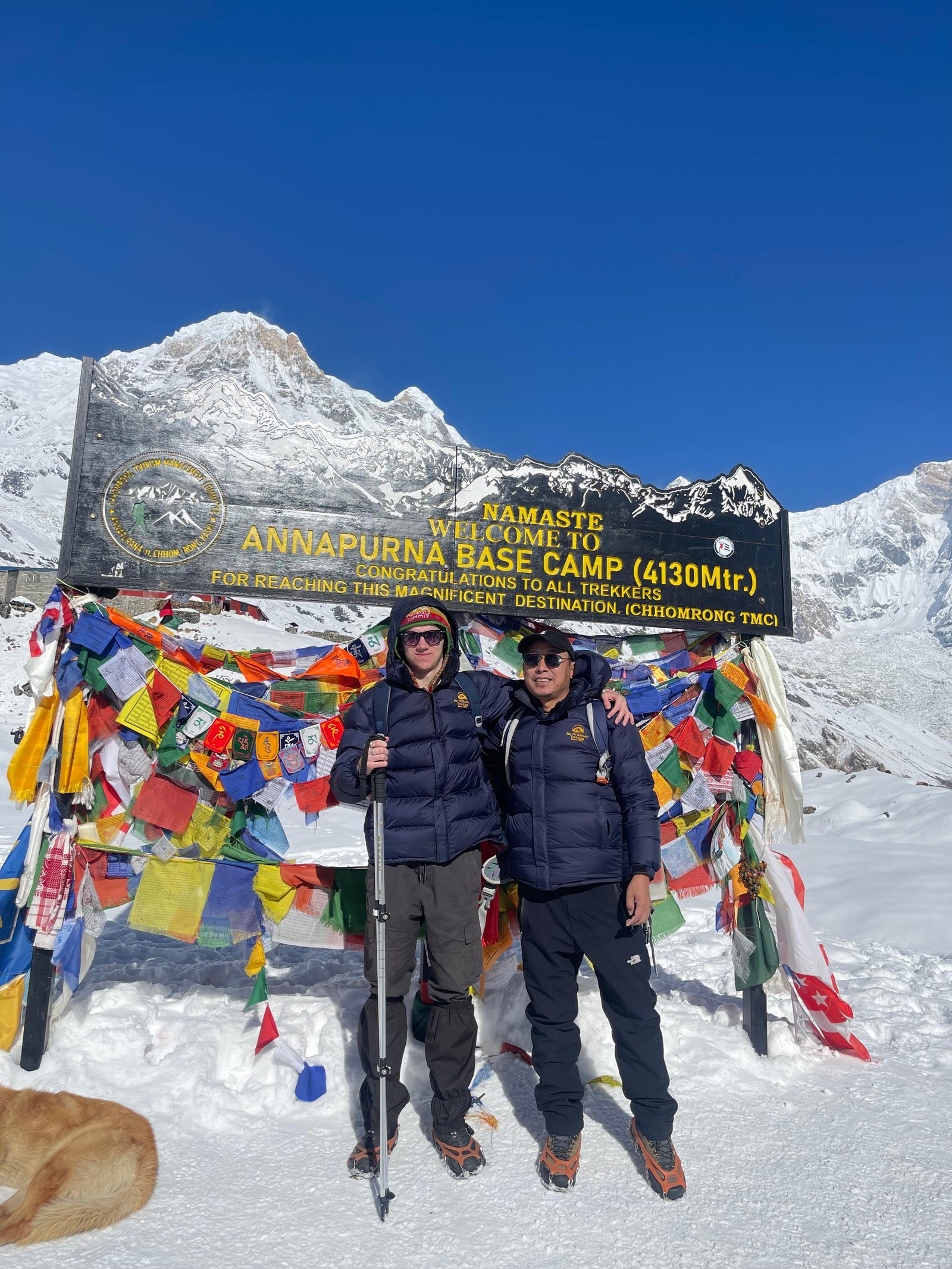
- Mani Walls & Prayer Flags: The approach through Ghandruk, Chhomrong, and the Modi Khola gorge is flanked by slate-carved mani walls inscribed with Om Mani Padme Hum. As you enter the rocky glacial bowl at 4,130 meters, lines of five-colored lungta (wind-horse prayer flags) stretch between moraine cairns, snapping in the wind to carry prayers of compassion toward the hanging ice sheets above.
Remarkable Biodiversity: The Annapurna Conservation Area
The Annapurna Conservation Area (ACAP)—Nepal’s first and largest conservation project—hosts one of the steepest ecological gradients on Earth:
- Flora: Within a few days of walking, subtropical banana and bamboo groves transition into dense temperate forests of blue pine, oak, and giant arboreal rhododendrons (blooming in fiery crimson, pink, and white throughout the spring). Above 3,500 meters, the canopy ends abruptly, giving way to dwarf birch, fragrant sunpati (Rhododendron anthopogon), alpine sedges, and tough lichens clinging to frozen granite.
- Fauna: The lower cloud forests shelter the shy and endangered Red Panda (Ailurus fulgens), barking deer, and troops of gray langurs swinging through the branches. The rocky crags around the Sanctuary are home to agile herds of Himalayan Tahr and Himalayan Blue Sheep (Bharal), closely hunted by the elusive Snow Leopard (Panthera uncia). In the skies overhead, Lammergeiers (bearded vultures) and golden eagles ride the massive thermal updrafts bouncing off the South Face.
Mountain Fuel: Gurung Hearth & Thakali Feasts
The valleys cradling the Annapurna massif are famous for providing some of the richest and most flavorful cuisine in the Himalayas:
- Authentic Thakali Dal Bhat: Hailing from the Thak Khola region along the Kali Gandaki, this legendary platter features aromatic local rice, creamy black lentil soup (maas ko dal), spicy fried wild mustard greens, radish pickle, and meat or potatoes seasoned with fragrant fried Jimbu (Himalayan chives).
- Gurung Bread with Wild Honey: Thick, golden rounds of wheat dough with parallel slits cut into the center, deep-fried until puffy and crisp, served with freshly collected mountain honey or melted yak butter.
- Garlic Soup & Apple Cider: Steaming bowls of garlic-heavy broth are downed by the bowlful at Deurali and Machapuchare Base Camp to assist with blood flow and acclimatization, while the lower valleys around Marpha and Mustang yield crisp organic apples, fresh apple pies, and spiced warm cider.
The Trek & Perspectives: Base Camp & The Circuit
Few mountain regions offer trekking routes as legendary and diverse as the Annapurna trails:
- Annapurna Base Camp (ABC / The Sanctuary): A classic 7- to 10-day trek up the narrow Modi Khola gorge, breaking out into the vast, natural amphitheater at 4,130 meters. Hikers stand surrounded by a 360-degree wall of frozen giants: Annapurna South (7,219 m), Hiunchuli, Machapuchare (6,993 m), and the colossal 3,000-meter wall of Annapurna I South Face.
- The Annapurna Circuit: The world-renowned 12- to 18-day odyssey that circles the entire massif, transitioning from lush green valleys into the arid Tibetan rain-shadow plateau of Manang, culminating in the grueling crossing of the Thorong La Pass (5,416 m) before descending to Muktinath and Jomsom.
Best Seasons:
- Autumn (October–November): The undisputed premier window, boasting crisp cloudless skies, razor-sharp visibility, and stable mountain conditions.
- Spring (March–May): The season of blossoms, when entire hillsides below Ghorepani and Tadapani ignite in wild rhododendron flowers beneath gleaming white peaks.
Annapurna I stands as a timeless monument to human ambition, natural power, and spiritual reverence. It is a peak that demands complete humility: a goddess of plenty whose lower slopes sustain ancient communities and terraced valleys, paired with an unforgiving high-altitude ice wall that has challenged the world’s greatest mountaineers. To stand in the crisp dawn chill of the Annapurna Sanctuary, watching the first rays of sunlight turn the 8,091-meter south wall into liquid gold while avalanches rumble quietly across the glacial floor, is an encounter with the divine scale of the Himalayas that forever alters how you see the world.