Dhaulagiri I (8,167 m)
Preview Teaser:
Once believed to be the highest point on Earth, the "White Mountain" rises in a colossal 4,000-meter wall of ice above the world’s deepest gorge, defying storms and humbling generations of alpinists.
Soaring to an immense 8,167 meters (26,795 ft) in west-central Nepal, Dhaulagiri I is the seventh-highest mountain on Earth. Anchoring the western side of the Kali Gandaki River, it stands directly opposite Annapurna I, with the river between them carving the deepest gorge in the world.
Dhaulagiri boasts staggering vertical relief: its south and west faces soar over 4,000 meters from their immediate valleys in a near-vertical rise of sheer rock, serac bands, and tumbling avalanche gullies. For over thirty years in the 19th century—before the Great Trigonometrical Survey surveyed Kangchenjunga and Everest—the Western world believed this immense white monolith was the highest point on the planet.
History: The Swiss-Austrian Aerial Expedition of 1960
Dhaulagiri gained an early reputation as a notoriously difficult 8,000er, turning back eight expeditions throughout the 1950s—including the pioneering French team of 1950, who abandoned Dhaulagiri to make their historic first ascent of Annapurna instead.
Official victory finally came on May 13, 1960, by a joint Swiss-Austrian-Nepali expedition led by Max Eiselin. The climb made alpine history not only for conquering the technical Northeast Ridge but also for utilizing a prototype glacier-landing ski airplane named the Yeti (a Pilatus PC-6 Porter) to ferry supplies directly onto the high pass of the Dambush Col at 5,700 meters. The plane eventually crash-landed during an attempted takeoff (miraculously without casualties), leaving the climbers to finish the ascent and descent in pure foot-powered alpine style. Kurt Diemberger, Peter Diener, Ernst Forrer, Albin Schelbert, and Sherpa legends Nawang Dorje and Nyima Dorje stood atop the windswept crown.
Myth & Sacred Lore: The Dhavala Giri
The name Dhaulagiri originates from the Sanskrit roots Dhavala (meaning dazzling white, beautiful, or pure) and Giri (mountain)—literally translating to "The Dazzling White Mountain."
- The Throne of Purity: In regional Hindu cosmology, the dazzling symmetry of Dhaulagiri’s white walls is revered as an earthly throne of purity dedicated to Lord Shiva and the goddess Parvati. Its gleaming apex, towering untouched over the mist-filled canyons of the Kali Gandaki, was seen as a celestial beacon guiding wandering ascetics along their path toward liberation (moksha).
- The Wrathful Winds of the West: Local Magar, Gurung, and Thakali communities historically regarded the mountain with deep awe and trepidation. The violent west-wind gales that frequently whip off Dhaulagiri’s south face, blowing plumes of powdered snow miles across the sky, are believed to be the breath of protective mountain spirits warning mortals not to intrude into the high ice sanctuaries.
The Buddhist Legacy: Chortens of the Hidden Valley
While Dhaulagiri marks the transition into the Hindu-dominated mid-hills to the south, its high passes and valleys are deeply tied to Tibetan Buddhist geography:
- The Sacred Hidden Valley: Trekkers tracing the Dhaulagiri Circuit cross into the legendary Hidden Valley—a desolate, wind-swept, high-altitude desert plateau situated at 5,000 meters behind Dhaulagiri and the Dhaulagiri ridge. To local lamas, this untouched expanse mirrors the concept of a sacred Beyul, a refuge preserved by nature’s fiercest elements where spiritual practitioners could find absolute silence away from worldly conflict.
- Prayer Flags on the French Pass: At the crest of the French Col (French Pass, 5,360 m), lines of five-colored lungta (wind-horse prayer flags) are tied to stone cairns, snapping violently in the sub-zero gusts to send prayers of protection and compassion across the glaciated void toward the Churen Himal and Dhaulagiri II, III, and IV.
Raw Alpine Ecology: From Myagdi Cloud Forests to Arctic Moraines
The Dhaulagiri basin offers one of the steepest, most undisturbed wilderness gradients in the Himalayas:
- Flora: Starting from the lush banks of the Myagdi Khola, the trail climbs through subtropical bamboo thickets, oak woodlands, and moss-hung rhododendron forests. Beyond Italian Base Camp (3,660 m), the forest ends abruptly. The trail enters a dramatic glaciated gorge flanked by sheer granite cliffs, where vegetation is reduced to hardy alpine mosses, dwarf juniper scrub (sunpati), and lichens clinging to frozen scree.
- Fauna: Because the Dhaulagiri Circuit bypasses large settlements, wildlife flourishes in the quiet side valleys. The bamboo thickets harbor the endangered Red Panda (Ailurus fulgens) and musk deer. Higher along the rocky moraines and lateral scree shelves, herds of Himalayan Blue Sheep (Bharal) navigate dizzying ledges, trailed by the elusive Snow Leopard (Panthera uncia). Overhead, lammergeiers (bearded vultures) and golden eagles carve through the updrafts rising from the Kali Gandaki gorge.
Mountain Fuel: Magar Hospitality & High-Camp Sustenance
The approach through the Myagdi district introduces trekkers to rustic, home-style cooking before shifting to high-altitude expedition rations:
- Myagdi Kodo ko Dheedo: A steaming, dense mound of boiled finger-millet flour, scooped up with fingers and paired with rich, spicy country chicken curry or wild leafy mustard greens (Toriko Saag).
- Garlic Broth & Potato Curry: Relied upon heavily at Italian Base Camp and Dhaulagiri Base Camp to dilate blood vessels and assist with acclimatization, served alongside heaping bowls of spiced mountain potatoes and hot lentil soup.
- Tsampa & Yak Butter Tea: High on the glaciated camps where water must be melted over portable stoves, roasted barley flour (Tsampa) mixed with hot milk or salted butter tea provides the calorie-dense, slow-burning fuel essential for braving sub-zero nights.
The Trek: The Formidable Dhaulagiri Circuit
The Dhaulagiri Circuit is universally recognized as one of the most physically demanding, wilderness-heavy teahouse-and-camping routes in Nepal:
- The Myagdi Gorge & Italian Base Camp: Leaving the roadhead at Beni or Darbang, hikers follow the Myagdi Khola up a narrow, cliff-bound river canyon that feels like a forgotten world, acclimatizing under the towering west wall of Dhaulagiri at Italian Base Camp (3,660 m).
- Dhaulagiri Base Camp (4,748 m): Perched directly on the rubble and ice of the Chhonbardan Glacier, Base Camp sits right beneath the immense, avalanche-swept North Face of Dhaulagiri I—an amphitheater of groaning ice and tumbling seracs.
- The High Alpine Crossing (French Pass & Dhampus Pass): The crux of the trek requires crossing two consecutive 5,000-meter saddles: the French Pass (5,360 m) into the uninhabited Hidden Valley, followed by the Dhampus Pass (5,244 m), before plunging down a grueling descent into the windswept apple orchards of Marpha and the Kali Gandaki valley.
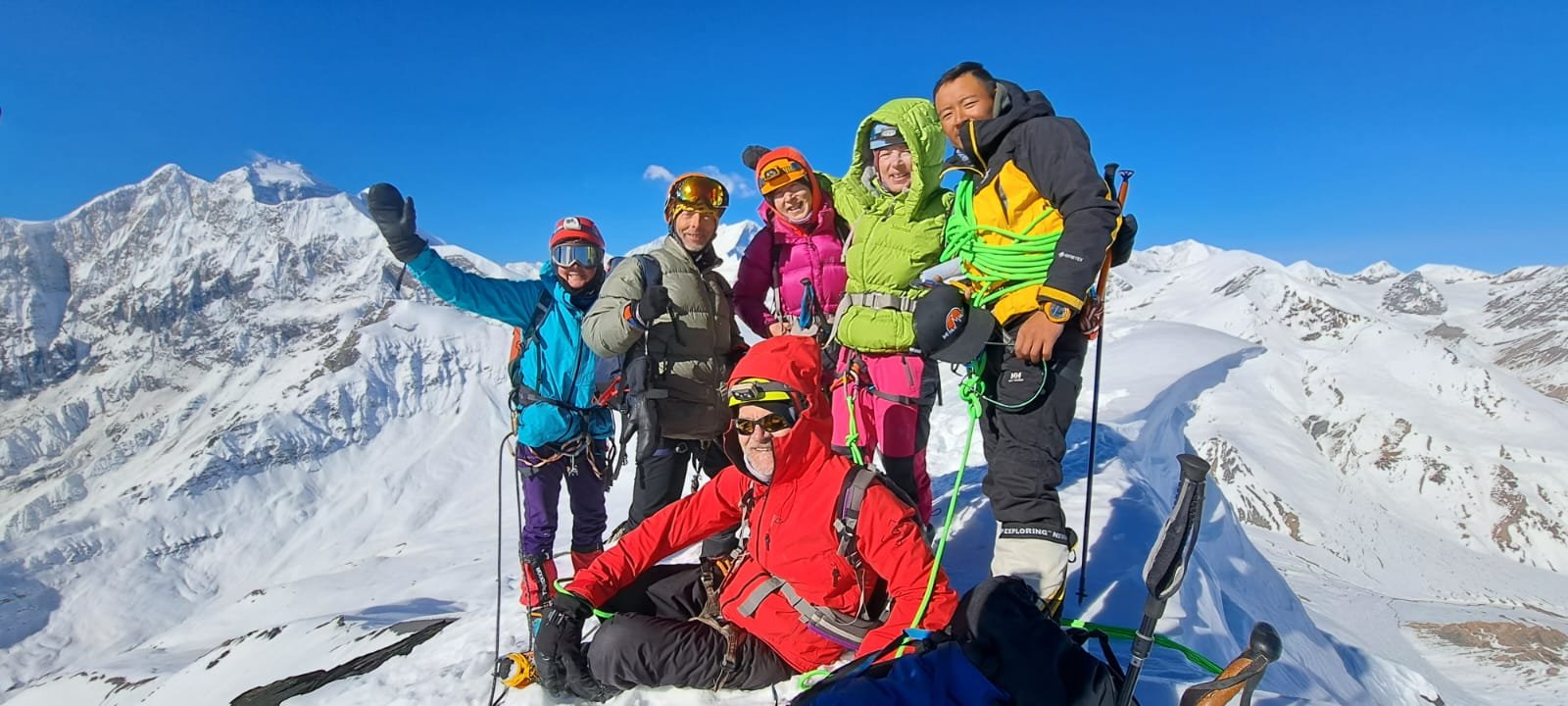
Dhampush Peak Summit alt.6012 mtr on 20th Feburary 2022
Best Seasons:
- Autumn (October–November): The prime window, offering crisp skies, minimal snow accumulation on the high passes, and stable glacier walking conditions.
- Spring (April–May): Beautiful blooming forests in the lower Myagdi valley, though crossing the French Pass requires careful navigation around winter snowpack.
Dhaulagiri I is an enduring testament to the raw, untamed majesty of the high Himalayas. It makes no compromises for travelers; every step beneath its colossal white face must be earned through rugged river gorges, shifting moraines, and freezing alpine passes. To stand in the silence of the Hidden Valley as evening light paints Dhaulagiri’s 8,167-meter crown in shades of fire and gold is to witness the Earth at its most dramatic—an encounter with the dazzling White Mountain that leaves an indelible mark on the soul.