Rising to an immense height of 8,586 meters (28,169 ft), Kangchenjunga is the world’s third-highest mountain and the undisputed titan of the eastern Himalayas. Straddling the remote border between eastern Nepal and Sikkim, this colossal massif is not just a single peak—it is an enormous wall of ice and rock featuring five distinct summits, each soaring above 8,400 meters.
Before Great Trigonometrical Survey measurements in the mid-19th century demoted it behind Everest and K2, the world believed Kangchenjunga was the highest point on Earth. Even today, with its wild approaches and unpredictable weather, it remains one of the most revered and rugged wilderness frontiers on the planet.
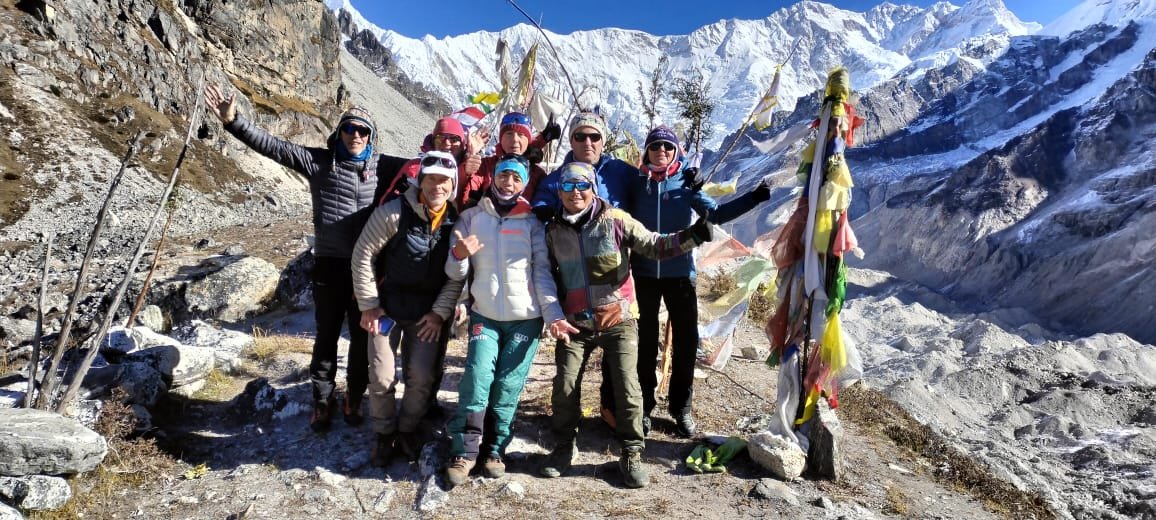
GHT TEAM AT KANCHANJUNGA North Base Camp (Pangpema) OCTOBER 2025.
The mountain was first climbed on May 25, 1955, by British mountaineers Joe Brown and George Band. However, in a display of cultural respect that mirrored the ascent of Machapuchare, the expedition made a promise to the Chogyal (King) of Sikkim: they would stop a few feet short of the actual apex so that the sacred summit remained untouched by human crampons. Most mountaineers to this day voluntarily honor this tradition, treating the very pinnacle as holy ground.
The name Kang-chen-dzö-nga translates in Tibetan to "The Five Treasures of the Great Snow." According to Himalayan Buddhist belief, the mountain is a massive natural vault containing five divine repositories that the gods will unlock only in times of global peril:
For the indigenous Limbu and Rai peoples of eastern Nepal, Kangchenjunga (revered locally as Sewa Lungma) is the sacred abode of the mother goddess Tagera Ningwaphumang (Yuma Sammang). It is considered the spiritual cradle of Kirat civilization, where the souls of ancestors dwell among the high snowfields. Damaging or disrespecting the massif is believed to disturb the cosmic balance of rain and harvest across the eastern valleys.
Like the Khumbu and Langtang valleys, the Kangchenjunga region is revered as part of the hidden sanctuaries (Beyul) blessed by Guru Padmasambhava in the 8th century. Sacred texts describe the mountain as the eastern gatekeeper protecting the dharma. The trails winding through Ghunsa and Phale are lined with ancient Tibetan-style wooden gompas, mani walls carved with ancient scripts, and wind-horse prayer flags (lungta) sending mantras across the ice.
Because it lies farther east, the Kangchenjunga Conservation Area receives heavy monsoon rains, resulting in staggering biodiversity that transitions rapidly from subtropical jungle to barren alpine scree:
The cuisine in eastern Nepal blends Sherpa, Tibetan, and Kirati traditions, serving up fuel that warms you from the inside out:
Trekking Kangchenjunga is a true wilderness expedition—far removed from the commercial bustle of popular trails:
Best Seasons:
Mount Kangchenjunga remains the ultimate frontier of the Nepal Himalayas. It is a rare realm where ancient Kirat spirits, Buddhist sacred vaults, and towering granite walls converge in raw, unfiltered wilderness. To trek beneath its five peaks is to leave the modern world behind—journeying into an untouched corner of the earth where the mountain is not just an obstacle to climb but a living sacred presence that stays with you long after the journey ends.