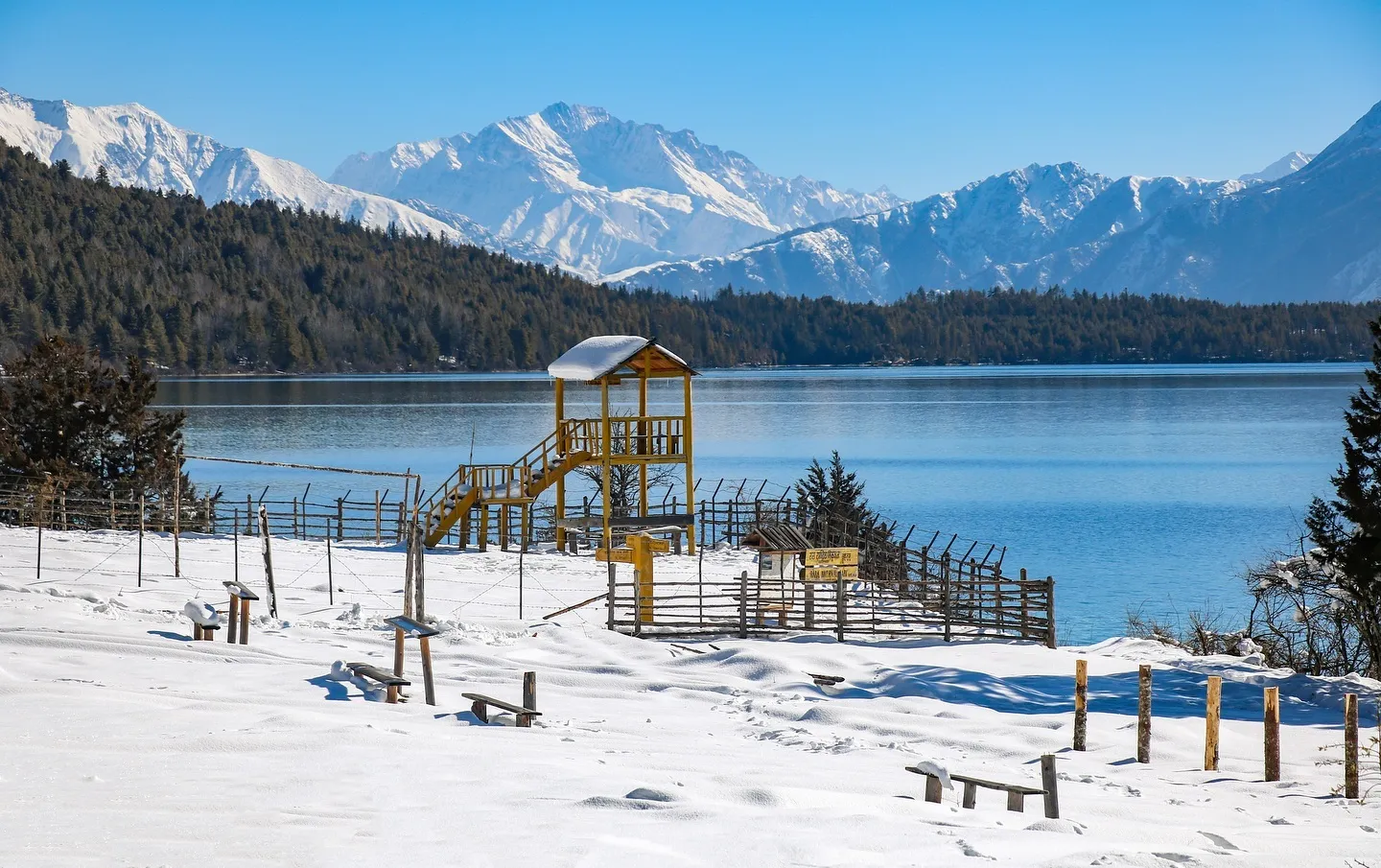
Resting at an elevation of 2,990 meters (9,810 ft) in the remote Mugu District of Karnali Province, Rara Lake—poetically hailed as the "Queen of Lakes" (Apsara of Heaven)—is the largest and deepest freshwater lake in Nepal. Spanning roughly 10.8 square kilometers with a maximum depth of 167 meters (548 ft), this pristine oval basin holds nearly 400 million cubic meters of crystal-clear meltwater, emptying into the Mugu Karnali River via the Nijar Khola.
Unlike the sheer granite gorges and high-altitude screes of the central Himalayas, Rara is cradled within gentle, rolling hills carpeted in thick coniferous forests. Because the lake sits far out in northwestern Nepal, away from major highway networks, it preserves an ancient, untouched tranquility. On a still morning, the water functions as a colossal liquid mirror, reflecting the blue sky, forested shorelines, and the distant snowy peaks of the Kanjirowa Himal in shades that shift from turquoise to deep indigo throughout the day.
History & The Royal Naming: King Mahendra’s Tribute
For centuries, the lake was known simply as Mugu Ko Dah (Mugu Lake) by local communities. Its modern cultural identity changed permanently in 1964, when late King Mahendra Bir Bikram Shah made a long, arduous trek on horseback through the remote hills of Jumla and Mugu.
Captivated by its ethereal stillness, King Mahendra camped along its northeastern banks and composed a famous poem honoring its beauty: "Rara, a nymph of heaven fallen to earth." He formally renamed it Rara Taal and decreed that the surrounding basin be protected. In 1976, Rara National Park was gazetted as Nepal’s smallest national park (106 sq km) to preserve the lake’s delicate watershed. To protect the water from organic pollution and erosion, the historic villages of Rara and Chapra were resettled to the lowlands of Nepalgunj, leaving the shores virtually uninhabited except for park rangers and travelers.
Myth & Sacred Lore: The Creation of the Sapphire Abyss
In the rich folklore of the Karnali region, Rara Lake is steeped in dramatic mythological origins:
- The Arrow of Lord Mahadev (Shiva): Regional lore tells of a demonic serpent that once ruled over a dry, scorched valley, hoarding the mountain springs and bringing devastating drought to the people of Mugu. Pitying the starving villagers, Lord Shiva fired a divine celestial arrow into the valley floor. The arrow shattered the earth, unsealing deep subterranean aquifers that rapidly filled the chasm with crystalline water, drowning the demon and restoring fertility to the land.
- The Abode of Thakur Baba: On the southeastern shore of the lake stands the shrine of Thakur Baba, the guardian deity of Rara. Local traditions recount that Thakur Baba shot arrows through the surrounding hills to create drainage passages so the water would not drown neighboring valleys. Herders and pilgrims still offer prayers, unhusked barley, and bell sacrifices at the shrine, believing that displaying disrespect or polluting the lake will provoke Thakur Baba into unleashing sudden hailstorms and livestock sickness.
Cultural Legacy: Khas Heartland & Masto Shamanism
The hills of Jumla and Mugu form the ancestral cradle of the ancient Khas Empire (which ruled western Nepal and western Tibet between the 11th and 14th centuries) and the birthplace of the original Khas language (the precursor to modern Nepali):
- The Masto Shrines & Wooden Deities: Throughout the nearby settlements of Murma and Pina, spiritual life revolves around ancient Masto animism. Stone shrines adorned with carved wooden pillars (dharo) honor clan deities. During village fairs, local shamans (Dhamis) don white turbans and enter trance states to channel mountain spirits.
- Murma Top (3,630 m): Perched directly above the lake’s western ridge is Murma village and the viewpoint of Murma Top. Inhabited by resilient Khas communities, the village preserves centuries-old agricultural traditions, flat-roofed mud-brick houses connected by notched-log ladders, and handlooms used to weave warm sheep’s-wool blankets (Radi-Pakhi).
Alpine Lake Ecology: Flora & Fauna of Rara National Park
Despite being Nepal’s smallest national park, Rara encompasses an exceptionally rich subalpine biosphere:
- Flora: The lake is encircled by dense, aromatic forests of blue pine (Pinus wallichiana), black juniper, West Himalayan spruce, deodar cedar, and silver fir. Lower wetland edges host thickets of dwarf rhododendron, wild rose, and yellow potentillas. In late spring and monsoon, the forest meadows carpet with wildflowers, blue gentians, and medicinal Himalayan herbs.
- Fauna: Rara is home to several endemic aquatic species found nowhere else on the planet, including the Nepalese Snowtrout (Schizothorax raraensis and Schizothorax macropthalmus). The dense shoreline woods harbor the endangered Red Panda (Ailurus fulgens), Musk Deer, Himalayan Black Bears, leopards, and agile troops of grey langurs. In autumn and spring, Rara serves as a critical stopover on the Trans-Himalayan flyway, attracting hundreds of migratory waterfowl including red-crested pochards, mallards, and coots.
Mountain Fuel: Rustic Karnali Hearthside Flavors
Dining in the villages and lakeside lodges of Mugu means enjoying the hearty, organic grains native to the cold western hills:
- Jumli Marshi Chamal ko Bhat: Mugu and neighboring Jumla are famous for Marshi—an ancient cold-tolerant red rice cultivated at the highest altitudes in the world. Dense, nutty, and slightly sweet, it is served with steaming bowls of mountain lentil soup (Daal) and spicy radish greens.
- Kaguno Kheer & Fapar ko Roti: A rich, comforting porridge made from wild foxtail millet (Kaguno) simmered in sweetened milk, paired with thick buckwheat flatbreads cooked over wood hearths and smeared with fresh cow ghee.
- Chuche Chyau Curry & Local Apple Treats: Seasonal curries made from wild morel mushrooms (Chuche Chyau) foraged from the pine forest floor, followed by dried apple slices or locally distilled organic apple brandy from the orchards of Jumla.
The Trek & Approaches: Journeying to the West
Reaching Rara is an unforgettable journey through the deep wilderness of western Nepal:
- The Flight & Trek via Talcha: The most common route involves flying from Nepalgunj to the cliffside airstrip at Talcha Airport (2,735 m) in Mugu. From Talcha, a scenic 3- to 4-hour hike through silent pine and rhododendron woods leads directly to the eastern shores of the lake.
- The Classic Jumla to Rara Circuit: For true trekkers, the classic trail begins at Jumla airstrip, crossing high mountain saddles like the Danphe Lagna Pass (3,500 m) and winding through traditional Khas villages like Chere Chaur, Sinja Valley (the historic capital of the Khas kings), and Ghorosingha before dropping down to the azure shores of Rara.
- Circumnavigating the Rim: A full loop on foot around Rara Lake takes roughly 5 to 6 hours along flat, mossy forest trails. Scrambling up to Murma Top (3,630 m) provides the ultimate bird’s-eye perspective: the entire oval mirror of the lake framed by endless green ridges, backed by the glistening white summits of Kanjirowa (6,883 m).
Best Seasons to Visit:
- Autumn (September – November): Crisp, cloudless skies, mirror-flat lake waters reflecting the snow peaks, and migratory birds arriving on the water.
- Spring (April – June): Forests erupting in wild rhododendron and iris blossoms, mild temperatures, and long sunny days ideal for walking and lakeside camping.
Rara Lake is a pristine, soul-stirring sanctuary that feels worlds away from the crowded paths of the Himalayas. Here, the mountains step back to let the water take center stage. There are no diesel engines, no towering hotel skylines, and no commercial noise—only the gentle lap of turquoise water against pebbled shores, the scent of blue pine needles in the mountain breeze, and the cry of wild eagles soaring over the lake. To watch the sunset fade across Rara as the evening stars emerge across a mirror of deep sapphire is to experience the quiet, untamed poetry of western Nepal at its very best.